170
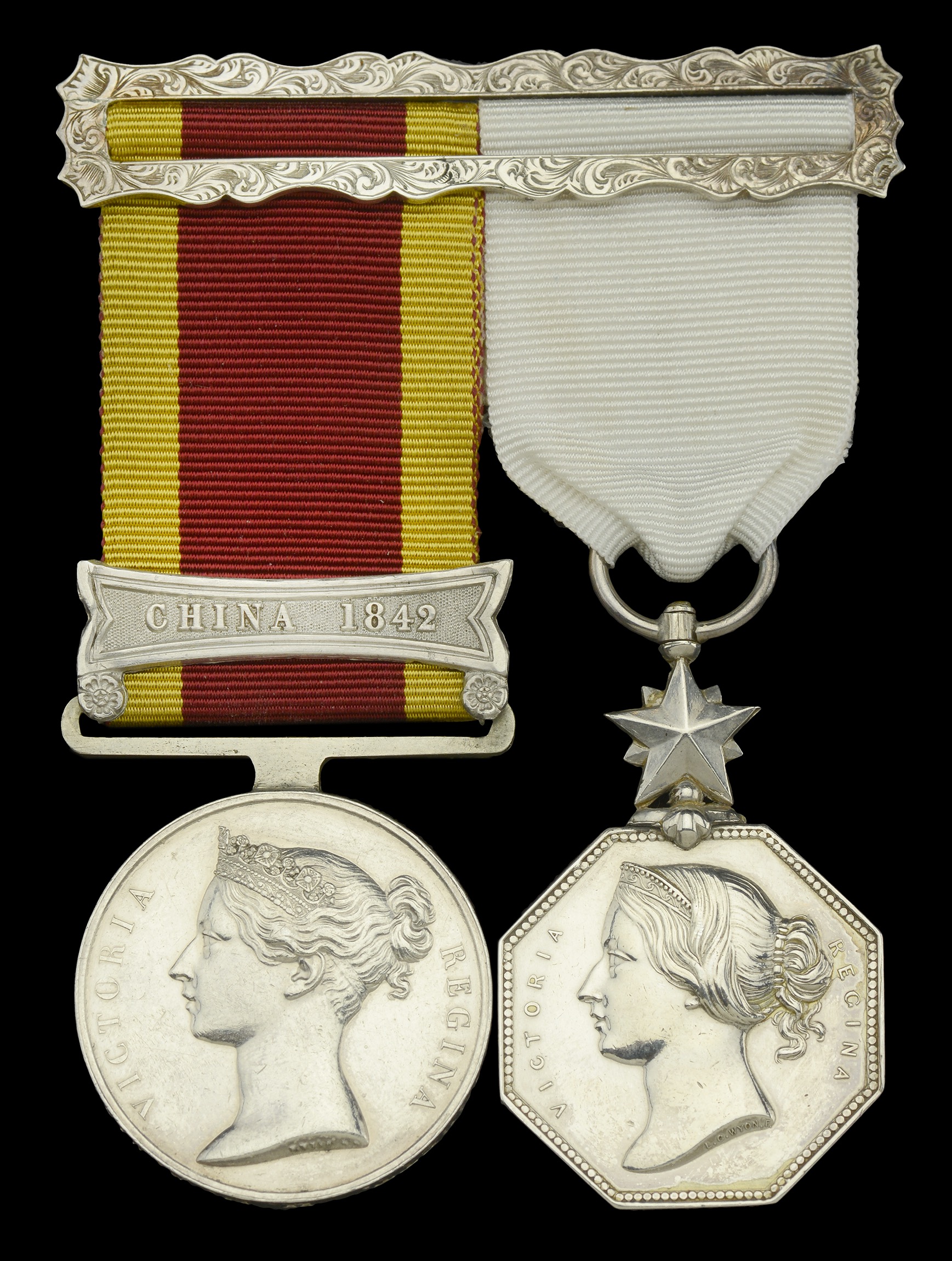
An extremely rare First and Second China Wars and Franklin Search Expedition pair awarded...
Your max bid
GBP
Place Bid
Auctioneer's estimate
5,000 GBP - 7,000 GBP
Additional fees apply
34.74% Inc.VAT/sales tax
Add to watch list
Watching
(4 watching)
Please confirm your bid
Bids do not include VAT, buyer’s premium or delivery.
By confirming your bid, you agree that you have read and accepted the-saleroom.com and the auctioneer's terms and conditions. Confirming your bid is a legally binding obligation to purchase and pay for the lot should your bid be successful.
Confirm bid removal
Your bid is off increment
Choose one of the quick bid options below:
Bids do not include VAT, buyer’s premium or delivery.
By confirming your bid, you agree that you have read and accepted the-saleroom.com and the auctioneer's terms and conditions. Confirming your bid is a legally binding obligation to purchase and pay for the lot should your bid be successful.


Description
An extremely rare First and Second China Wars and Franklin Search Expedition pair awarded to Chief Engineer W. Ibbett, Royal Navy
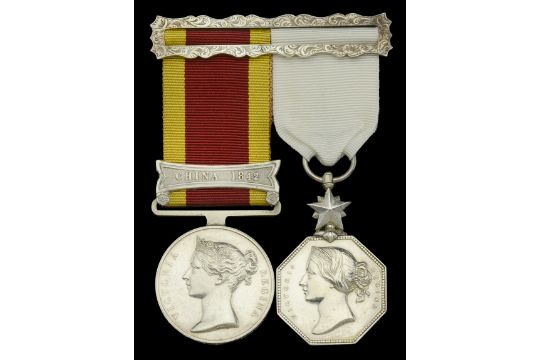
China 1842, 1 clasp, China 1842 (William Ibbett, H.M.S. Vixen) fitted with original straight bar suspension but with minor adaptation to take clasp; Arctic Medal 1818-55, unnamed as issued, suspension neatly re-affixed, good very fine (2) £5,000-£7,000
---
Provenance: Dix Noonan Webb, September 2005.
William Joseph Ibbett entered the Royal Navy in September 1841 as an Engineer’s Boy 4th Class serving aboard the Vixen. In her, he saw service in the First China War of 1842, with men of the Vixen taking part in the storming and capture of the city of Chin-Keang-Foo at the entrance of the South Grand Canal on the Yangtse-Kiang. Promoted Assistant Engineer 2nd Class in September 1846 and Engineer 1st Class in October 1851.
Ibbett served as Second Engineer on the Intrepid, 1852-54, on the last Government funded Franklin Search Expedition. Five ships were sent out under the command of Sir Edward Belcher - the Assistance, Pioneer, Resolute, Intrepid and North Star. Belcher was ordered to proceed to Beechey Island where the North Star was to remain as the depot ship whilst the Assistance and Pioneer were to proceed northward up the Wellington Channel and the Resolute and Intrepid were to sail west for Melville Island. Reaching Beechey Island by mid-1852, the ships then proceeded to their allotted stations. Heavy ice prevented the Resolute and Intrepid from reaching Melville Island and so based on Dealy Island nearby, preparations were made to carry out sledging journeys during the Autumn of 1852 and Spring of 1853 across to Melville Island. Ibbett is confirmed as having taken part in a sledging journey in British Polar Expeditions and Research. The sledging expeditions were successful in locating the men of the stranded Investigator (a ship of the 1850-53 Search Expedition) and discovering several new islands in the vicinity of Melville Island. The five ships were somewhat unfortunate in the latter part of the expedition, with the Assistance, Pioneer and Resolute all having to be abandoned to the ice.
Ibbett was promoted to Engineer in October 1854 and attained the rank of Chief Engineer in December 1859. Appointed to the iron screw troopship Urgent on the 9th of that month, he subsequently took part in the operations off the coast of China, for which he gained entitlement to the clasp ‘China 1842’.
In the latter years of his naval career, Ibbett’s service papers reveal a personal tragedy. An entry dated 1869 reads, ‘Wishes an early appointment, wife is a lunatic, has to employ a person for the care of his home’. Chief Engineer Ibbett retired from the Navy on 11 May 1876, and died on 2 December 1887.
Sold with copied service papers and other research.
China 1842, 1 clasp, China 1842 (William Ibbett, H.M.S. Vixen) fitted with original straight bar suspension but with minor adaptation to take clasp; Arctic Medal 1818-55, unnamed as issued, suspension neatly re-affixed, good very fine (2) £5,000-£7,000
---
Provenance: Dix Noonan Webb, September 2005.
William Joseph Ibbett entered the Royal Navy in September 1841 as an Engineer’s Boy 4th Class serving aboard the Vixen. In her, he saw service in the First China War of 1842, with men of the Vixen taking part in the storming and capture of the city of Chin-Keang-Foo at the entrance of the South Grand Canal on the Yangtse-Kiang. Promoted Assistant Engineer 2nd Class in September 1846 and Engineer 1st Class in October 1851.
Ibbett served as Second Engineer on the Intrepid, 1852-54, on the last Government funded Franklin Search Expedition. Five ships were sent out under the command of Sir Edward Belcher - the Assistance, Pioneer, Resolute, Intrepid and North Star. Belcher was ordered to proceed to Beechey Island where the North Star was to remain as the depot ship whilst the Assistance and Pioneer were to proceed northward up the Wellington Channel and the Resolute and Intrepid were to sail west for Melville Island. Reaching Beechey Island by mid-1852, the ships then proceeded to their allotted stations. Heavy ice prevented the Resolute and Intrepid from reaching Melville Island and so based on Dealy Island nearby, preparations were made to carry out sledging journeys during the Autumn of 1852 and Spring of 1853 across to Melville Island. Ibbett is confirmed as having taken part in a sledging journey in British Polar Expeditions and Research. The sledging expeditions were successful in locating the men of the stranded Investigator (a ship of the 1850-53 Search Expedition) and discovering several new islands in the vicinity of Melville Island. The five ships were somewhat unfortunate in the latter part of the expedition, with the Assistance, Pioneer and Resolute all having to be abandoned to the ice.
Ibbett was promoted to Engineer in October 1854 and attained the rank of Chief Engineer in December 1859. Appointed to the iron screw troopship Urgent on the 9th of that month, he subsequently took part in the operations off the coast of China, for which he gained entitlement to the clasp ‘China 1842’.
In the latter years of his naval career, Ibbett’s service papers reveal a personal tragedy. An entry dated 1869 reads, ‘Wishes an early appointment, wife is a lunatic, has to employ a person for the care of his home’. Chief Engineer Ibbett retired from the Navy on 11 May 1876, and died on 2 December 1887.
Sold with copied service papers and other research.
Auction Details
Shipping
T&Cs & Important Info
Ask seller a question
An extremely rare First and Second China Wars and Franklin Search Expedition pair awarded to Chief Engineer W. Ibbett, Royal Navy
China 1842, 1 clasp, China 1842 (William Ibbett, H.M.S. Vixen) fitted with original straight bar suspension but with minor adaptation to take clasp; Arctic Medal 1818-55, unnamed as issued, suspension neatly re-affixed, good very fine (2) £5,000-£7,000
---
Provenance: Dix Noonan Webb, September 2005.
William Joseph Ibbett entered the Royal Navy in September 1841 as an Engineer’s Boy 4th Class serving aboard the Vixen. In her, he saw service in the First China War of 1842, with men of the Vixen taking part in the storming and capture of the city of Chin-Keang-Foo at the entrance of the South Grand Canal on the Yangtse-Kiang. Promoted Assistant Engineer 2nd Class in September 1846 and Engineer 1st Class in October 1851.
Ibbett served as Second Engineer on the Intrepid, 1852-54, on the last Government funded Franklin Search Expedition. Five ships were sent out under the command of Sir Edward Belcher - the Assistance, Pioneer, Resolute, Intrepid and North Star. Belcher was ordered to proceed to Beechey Island where the North Star was to remain as the depot ship whilst the Assistance and Pioneer were to proceed northward up the Wellington Channel and the Resolute and Intrepid were to sail west for Melville Island. Reaching Beechey Island by mid-1852, the ships then proceeded to their allotted stations. Heavy ice prevented the Resolute and Intrepid from reaching Melville Island and so based on Dealy Island nearby, preparations were made to carry out sledging journeys during the Autumn of 1852 and Spring of 1853 across to Melville Island. Ibbett is confirmed as having taken part in a sledging journey in British Polar Expeditions and Research. The sledging expeditions were successful in locating the men of the stranded Investigator (a ship of the 1850-53 Search Expedition) and discovering several new islands in the vicinity of Melville Island. The five ships were somewhat unfortunate in the latter part of the expedition, with the Assistance, Pioneer and Resolute all having to be abandoned to the ice.
Ibbett was promoted to Engineer in October 1854 and attained the rank of Chief Engineer in December 1859. Appointed to the iron screw troopship Urgent on the 9th of that month, he subsequently took part in the operations off the coast of China, for which he gained entitlement to the clasp ‘China 1842’.
In the latter years of his naval career, Ibbett’s service papers reveal a personal tragedy. An entry dated 1869 reads, ‘Wishes an early appointment, wife is a lunatic, has to employ a person for the care of his home’. Chief Engineer Ibbett retired from the Navy on 11 May 1876, and died on 2 December 1887.
Sold with copied service papers and other research.
China 1842, 1 clasp, China 1842 (William Ibbett, H.M.S. Vixen) fitted with original straight bar suspension but with minor adaptation to take clasp; Arctic Medal 1818-55, unnamed as issued, suspension neatly re-affixed, good very fine (2) £5,000-£7,000
---
Provenance: Dix Noonan Webb, September 2005.
William Joseph Ibbett entered the Royal Navy in September 1841 as an Engineer’s Boy 4th Class serving aboard the Vixen. In her, he saw service in the First China War of 1842, with men of the Vixen taking part in the storming and capture of the city of Chin-Keang-Foo at the entrance of the South Grand Canal on the Yangtse-Kiang. Promoted Assistant Engineer 2nd Class in September 1846 and Engineer 1st Class in October 1851.
Ibbett served as Second Engineer on the Intrepid, 1852-54, on the last Government funded Franklin Search Expedition. Five ships were sent out under the command of Sir Edward Belcher - the Assistance, Pioneer, Resolute, Intrepid and North Star. Belcher was ordered to proceed to Beechey Island where the North Star was to remain as the depot ship whilst the Assistance and Pioneer were to proceed northward up the Wellington Channel and the Resolute and Intrepid were to sail west for Melville Island. Reaching Beechey Island by mid-1852, the ships then proceeded to their allotted stations. Heavy ice prevented the Resolute and Intrepid from reaching Melville Island and so based on Dealy Island nearby, preparations were made to carry out sledging journeys during the Autumn of 1852 and Spring of 1853 across to Melville Island. Ibbett is confirmed as having taken part in a sledging journey in British Polar Expeditions and Research. The sledging expeditions were successful in locating the men of the stranded Investigator (a ship of the 1850-53 Search Expedition) and discovering several new islands in the vicinity of Melville Island. The five ships were somewhat unfortunate in the latter part of the expedition, with the Assistance, Pioneer and Resolute all having to be abandoned to the ice.
Ibbett was promoted to Engineer in October 1854 and attained the rank of Chief Engineer in December 1859. Appointed to the iron screw troopship Urgent on the 9th of that month, he subsequently took part in the operations off the coast of China, for which he gained entitlement to the clasp ‘China 1842’.
In the latter years of his naval career, Ibbett’s service papers reveal a personal tragedy. An entry dated 1869 reads, ‘Wishes an early appointment, wife is a lunatic, has to employ a person for the care of his home’. Chief Engineer Ibbett retired from the Navy on 11 May 1876, and died on 2 December 1887.
Sold with copied service papers and other research.
Orders, Decorations, Medals and Militaria
Sale Date(s)
Venue Address
16 Bolton Street
London
W1J 8BQ
United Kingdom
General delivery information available from the auctioneer
If you are successful in purchasing lot/s being auctioned by us and opt for the item/s to be sent to you, we will use the following methods of shipment:
Within the UK
If you live within the UK, items will be despatched using Royal Mail Special Delivery. This service provides parcel tracking (via the Royal Mail website) and next weekday delivery (betwen 9am and 1pm). Items delivered within the UK are covered by our insurance company. Heavy and bulky lots will be sent by courier, in discussion with the client.
Outside of the UK
If the item/s being sent are worth under £1000 in total they are sent using Royal Mail’s Signed For International service. This ensures the item must be signed for when it is delivered.
If the item/s being sent are valued at over £1000 in total they will be sent using FedEx. This service allows next day delivery to customers in many parts of the US and parcels are fully trackable using the FedEx website.
Shipping Exceptions
Certain lots such as those containing glass or sharp implements, etc., may not be suitable for in-house shipping within or outside of the UK. Please contact Noonans with any queries.
Important Information
Auctioneer's Buyers Premium: 24% (+VAT)
There is an additional charge of 4.95% (+VAT/sales tax)